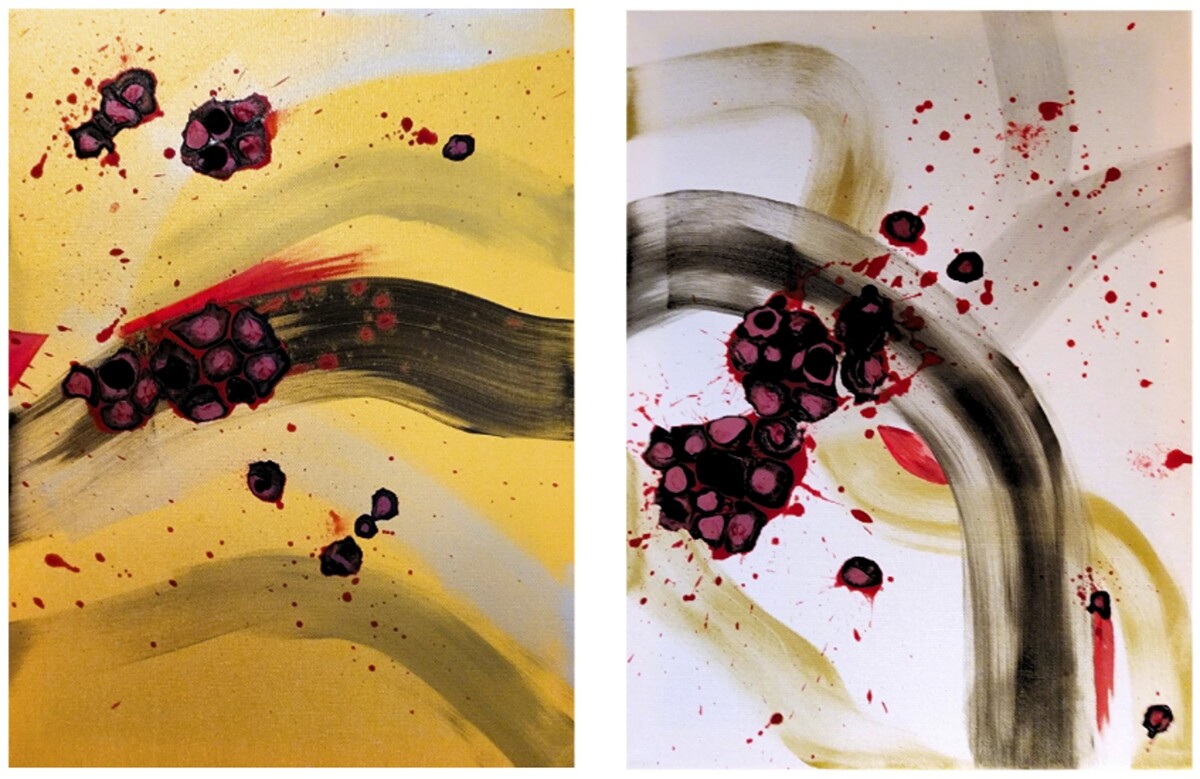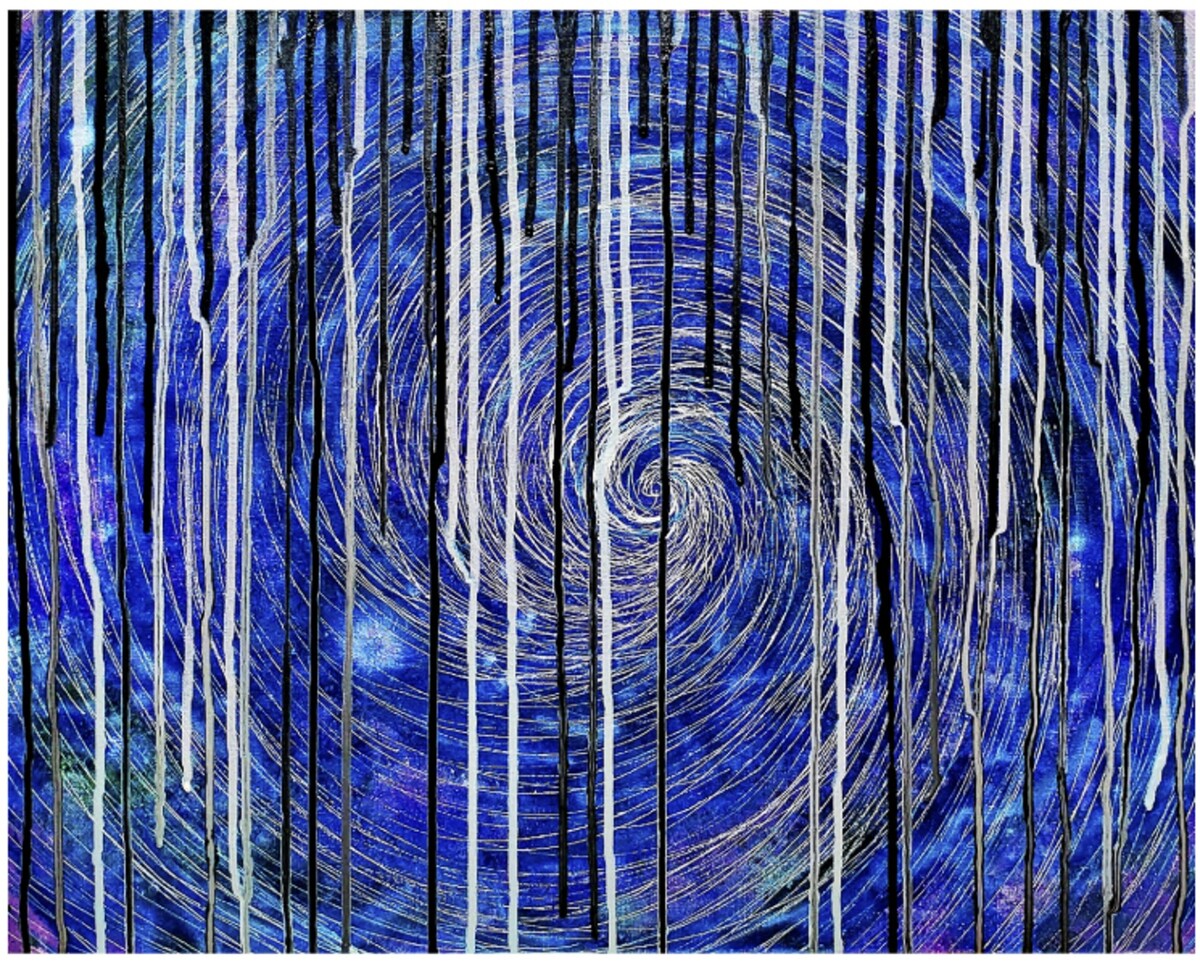
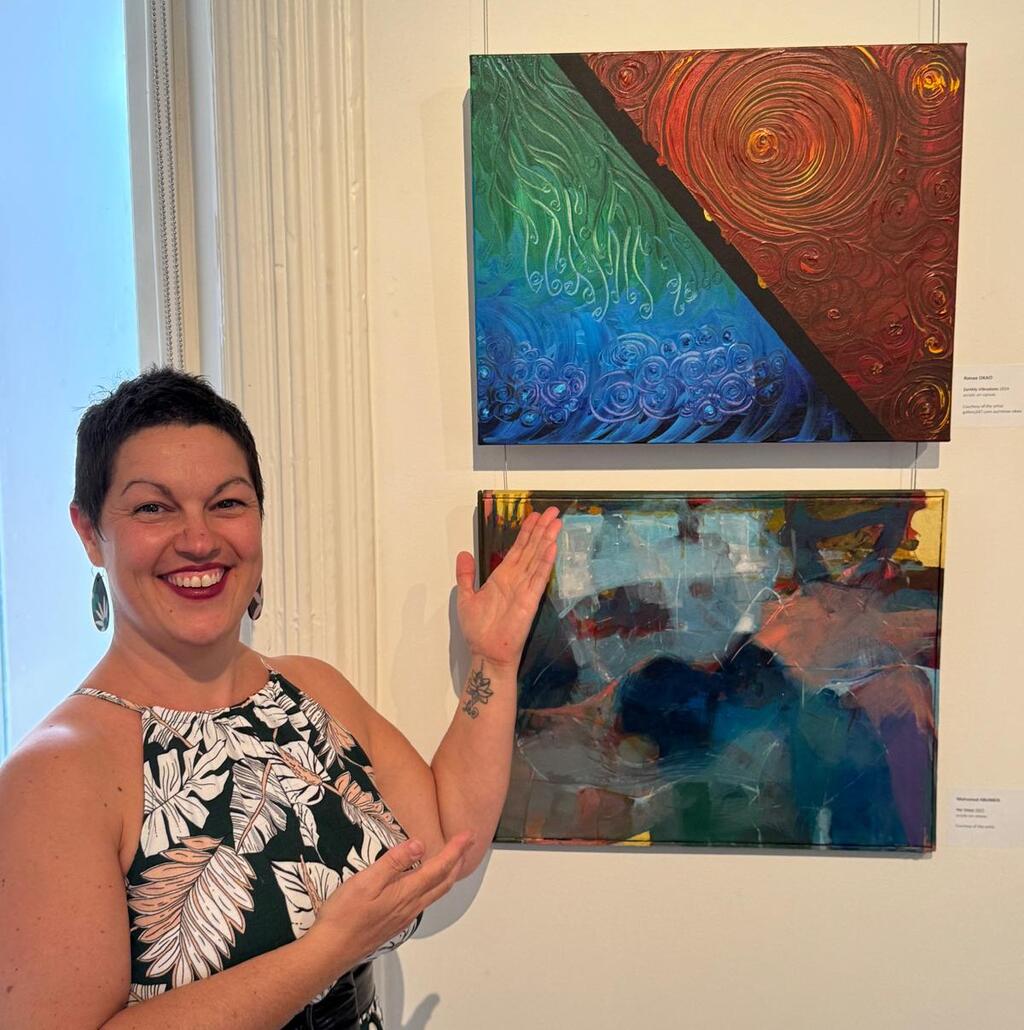
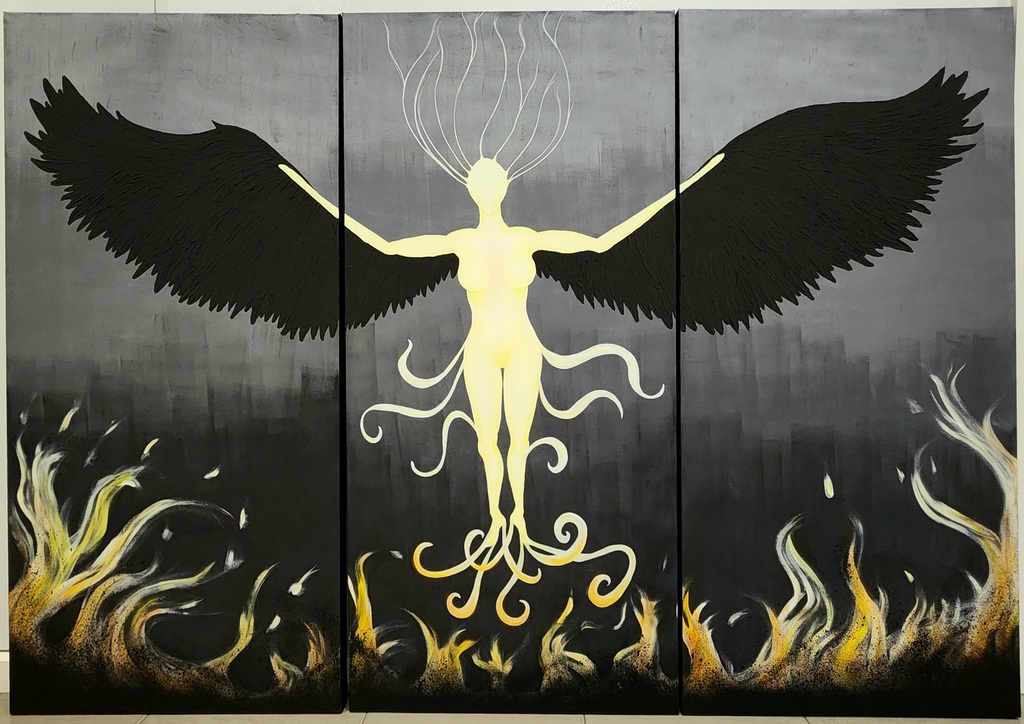
Completed in June 2026 and taking approximately 12 months to finish, the “Shenix” symbolises the human journey of transformation — the sacred cycle of burning, releasing, remembering, and rising. Across three canvases, a phoenix-like feminine figure emerges from flame and ash, her wide black wings stretching outward like a night sky unfolding.
The warm golds, oranges, and volcanic tones speak to the fire of renewal, while her soft white and yellow form reflects the light of consciousness returning to itself. Ribbon-like strands fall from her body into the flames, representing old stories, identities, patterns, and beliefs being released through growth and understanding.
This piece evokes the quiet power of becoming through unbecoming. “Shenix” honours the beauty of transformation, not as a forceful reinvention, but as a courageous return to what is true, rising slowly and honestly from what has been surrendered.
ART, Awareness & the Science of Becoming - The Story behind the She-nix
For almost twelve months, I lived alongside this painting, allowing it to unfold in its own time before it was finally complete.
Some of my paintings come into form quickly, as though they've travelled through a timeless channel from the great nothing, through imagination and onto a canvas with little or no resistance at all. This was not one of those paintings. It took almost close to a year to become fully formed, and depending on where the story begins, it was more like two to five years, if I'm really honest.
The first spark came as an idea. It was merely a fleeting image, a whisper carrying a message: “show me your phoenix”, there was an innate knowing that something was waiting to emerge.
Then it began forming in my imagination. I recalled a drawing I had made five years earlier, like a signal looping back through time, asking to be met again with different eyes.
When the first marks finally met the canvas, I thought I was the one creating the painting, but ironically, the painting was creating me too. I found that each new layer revealed something I had not yet seen, while the pauses in between asked that I be patient and trust the process.
Perhaps what it was really showing me was to trust the process of life.
Within that unfolding, I noticed a dance taking shape, a rhythm of movement and stillness, of stepping forward and pausing. There were times when I wanted certainty, when I wanted to finish it, even though I knew it was not yet ready to complete its cycle. There were other times when I questioned whether I knew what I was doing at all. The painting offered no answers, only an invitation to return again and again, allowing each brushstroke to guide the next, revealing something new as we moved together, one brushstroke at a time.
And slowly, in that dance of movement and stillness, she revealed herself.
Across three large canvases, a phoenix-like female figure emerged - “She-nix” - rising from the flames and the ashes.
Her body; shaped by subtle hues of white and sunshine yellow. Her wings stretched wide in textured matte black, spanning across the work like a night sky unfolding. Beneath her, gold and orange flames rise in a quiet choreography to gently kiss her feet, weaving through embers and volcanic remnants, framing the lower edge like a memory of the underworld, evidence of what has been transformed and returned to dust.
From her waist descend ribbon-like strands that peel away from her body, loosening their grip as they fall toward the fire. The old patterns and narratives, previous identities, beliefs, and former versions of self that once made sense and seemingly kept me safe now drop into the flames to burn away as part of the renewal. They are not discarded in anger or frustration; they're simply released through learning, growing and understanding, offered back to the flames that nourish and transform.
Emanating from the top of her head are delicate lines rippling upward into the unseen, symbols of possibility, potentiality and a change in frequency, like a consciousness remembering its own vastness in response to shedding identity and what is no longer true.
The phoenix is often remembered for its rising. Less often do we honour its burning. Yet the paradoxical nature of life asks for both in transformation:
- In our becoming, we are also unbecoming.
- It is through letting go of the old that we emerge as something new.
- We must leave behind one chapter so that we can begin writing the next anew.
Psychologically, symbols help us make sense of the invisible and the internal transitions that words alone cannot.
Jung wrote about archetypes as "pre-existent" forms in the collective unconscious, primordial images shared across humanity, shaping the patterns we live through long before we can explain them.
Reference:
- Jung, C. G. (1968). The archetypes and the collective unconscious (R. F. C. Hull, Trans.; 2nd ed., Vol. 9, Part 1). Princeton University Press. (Original work published 1959)
The phoenix appears across cultures and centuries because of the way it speaks to being human. We all seem to understand what it is to lose ourselves and then re-emerge. The symbol becomes a bridge between experience and meaning. It offers a way of seeing what is happening within us before we have the words to hold it.
This is one of the most magnificent things about art. It often speaks the truth before words arrive.
Research in neuroaesthetics and arts-in-health is increasingly showing that both making art and viewing art can shape the body's stress physiology, nervous system and engage brain systems linked to reward, emotion and meaning.
References:
- Kaimal, G., Ray, K., & Muniz, J. (2016). Reduction of cortisol levels and participants' responses following art making. Art Therapy, 33(2), 74–80. https://doi.org/10.1080/07421656.2016.1166832
- Lacey, S., Hagtvedt, H., Patrick, V. M., Anderson, A., Stilla, R., Deshpande, G., Hu, X., Sato, J. R., Reddy, S., & Sathian, K. (2011). Art for reward's sake: Visual art recruits the ventral striatum. NeuroImage, 55(1), 420–433. https://doi.org/10.1016/j.neuroimage.2010.11.027
- Fancourt, D., & Finn, S. (2019). What is the evidence on the role of the arts in improving health and well-being? A scoping review. World Health Organization Regional Office for Europe.
As the painting unfolded, I found myself reflecting on the subtle relationship between creativity, art-making and neuroplasticity. Curiosity, it seems, reveals another story, the story of the brain itself.
Neuroplasticity tells us that old neural pathways weaken through disuse, while new ones form through repetition, attention and experience. There is now substantial evidence showing that the brain is not fixed. Which means our perception and our identity is not fixed, and therefore our expression of self is not fixed either.
We are continually shaping and reshaping ourselves through what we practice, notice, believe and embody. Perhaps this is one reason art-making feels and is so transformative. It trains us to soften the reflex of judgement. It strengthens our capacity to be in the space of ambiguity and with what is unfinished. It invites a different orientation to life: presence, curiosity and patience. It allows us to witness change as it happens and to create change, to see what happens. A brushstroke changes a painting, just as a thought changes perception, and each change in perception reshapes the life we are creating.
It reminds us that internally, through our neural pathways, biology and chemistry, we are magnificent creations. Works of art. Moving masterpieces. The ART is me.
And so too, “The ART is You”.
The more I move through this journey we call life, the more I see creativity as a practice of awakening, a continual recalibration, a gentle peeling back of layers that no longer belong. Art-making has taught me that a painting cannot be forced into becoming itself. Instead, it unfolds through relationship: with the canvas, with the process and with myself. My role is not to control the outcome, but simply to show up, to witness and to remain present with uncertainty as colour, form and meaning gradually reveal themselves. There is no certainty in this process, only presence, trust and participation.
And perhaps the same can be said of life itself.
At times, the "now" flowed with remarkable clarity, like a breath of clean air. During those experiences, I noticed I was stepping out of my human story and into simple presence. It felt as though life was painting the phoenix through me. There was Awareness observing life.
As those experiences faded, what remained was their neurological imprint. A reminder that limitation and lack are, more often than not, learned constructs. This is why I believe the process matters as much as, perhaps even more than, the product itself.
The painting is an outcome. It stands as evidence that transformation takes place. But the process of transformation, and our awareness of it as it unfolds, is the key to intentional change.
We live in a time where science is catching up with what artists, mystics and embodied practitioners have known for centuries: awareness and focused attention change the brain, while repeated experience changes the body's sense of possibility.
Neuroscience, biology, chemistry and even the more speculative edges of physics, when held carefully, continue pointing toward the same invitation: the world is more changeable than we were taught to believe.
Art belongs in that conversation because it's a kind of science too. Not the science we study through formal education (although, I believe we should), but perhaps a more intimate science: one of self-education, inner experimentation, discovery, hypothesis, trial, error, iteration and integration.
A science of the self.
Even MIT has built this bridge into its teaching. In Vision in Art and Neuroscience (9.72/9.720), neuroscience students learn core principles of visual perception through studio-based art practice, developing works for exhibition and treating art-making as a way to explore and externalise how perception itself is constructed.
References:
- Sinha, P. (2017–2018). Pawan Sinha's “Vision in Art and Neuroscience” (Mellon Faculty Grant project page). MIT Center for Art, Science & Technology (CAST).
- Gonick, M. (2021, December 16). Video: Vision in Art and Neuroscience. MIT Department of Brain and Cognitive Sciences.
- Massachusetts Institute of Technology. (n.d.). Vision in Art and Neuroscience.
And my She-nix, she stands three canvases wide, as a witness to passage, to what burns away and to what rises. She is a symbol of what happens when you allow an old version of yourself to fall into the fire with reverence, until what is true can take shape, slowly and honestly, layer by layer, until it can finally be seen.
And perhaps that is the quiet work of art: not to make us into someone else, but to gently reveal the masterpiece that has always been there, waiting to be seen.
Reference links
- Jung, C. G. — The Archetypes and the Collective Unconscious (Princeton University Press): https://press.princeton.edu/books/hardcover/9780691097619/the-collected-works-of-c-g-jung-volume-9-part-1
- Kaimal, G., Ray, K., & Muniz, J. (2016) — Reduction of cortisol levels and participants' responses following art making: https://doi.org/10.1080/07421656.2016.1166832
- Lacey, S., Hagtvedt, H., Patrick, V. M., Anderson, A., Stilla, R., Deshpande, G., Hu, X., Sato, J. R., Reddy, S., & Sathian, K. (2011) — Art for reward's sake: Visual art recruits the ventral striatum: https://doi.org/10.1016/j.neuroimage.2010.11.027
- Fancourt, D., & Finn, S. (2019) — What is the evidence on the role of the arts in improving health and well-being? A scoping review: https://iris.who.int/items/ba079951-0beb-4b7f-a1c5-a75cc66c283e
- MIT Center for Art, Science & Technology — Pawan Sinha's Vision in Art and Neuroscience: https://arts.mit.edu/people/pawan-sinha/
- MIT Department of Brain and Cognitive Sciences / MIT News — Video: Vision in Art and Neuroscience: https://bcs.mit.edu/news/video-vision-art-and-neuroscience
- MIT course site — Vision in Art and Neuroscience (9.72 / 9.720): https://vision.mit.edu/